Recognizing the Patterns of Abuse: Power and Control
When people hear the words domestic violence, they may immediately think of physical violence. But abuse is not always visible. That is why understanding power and control matters.
Understanding the Power & Control Wheel: Recognizing the Patterns of Abuse
When people hear the words domestic violence, they may immediately think of physical violence.
But abuse is not always visible.
It can look like isolation. Intimidation. Threats. Humiliation. Financial control. Jealousy. Monitoring. Manipulation. It can happen gradually, through patterns of behavior that make someone feel smaller, more afraid, and less able to make their own choices.
That is why understanding power and control matters.
The National Domestic Violence Hotline describes domestic violence as a pattern of behaviors used to gain or maintain power and control over a partner. To help explain these patterns, The Hotline uses the Power and Control Wheel, originally developed by the Domestic Abuse Intervention Project in Duluth, Minnesota.
View the Power & Control Wheel from The National Domestic Violence Hotline
What is the Power & Control Wheel?
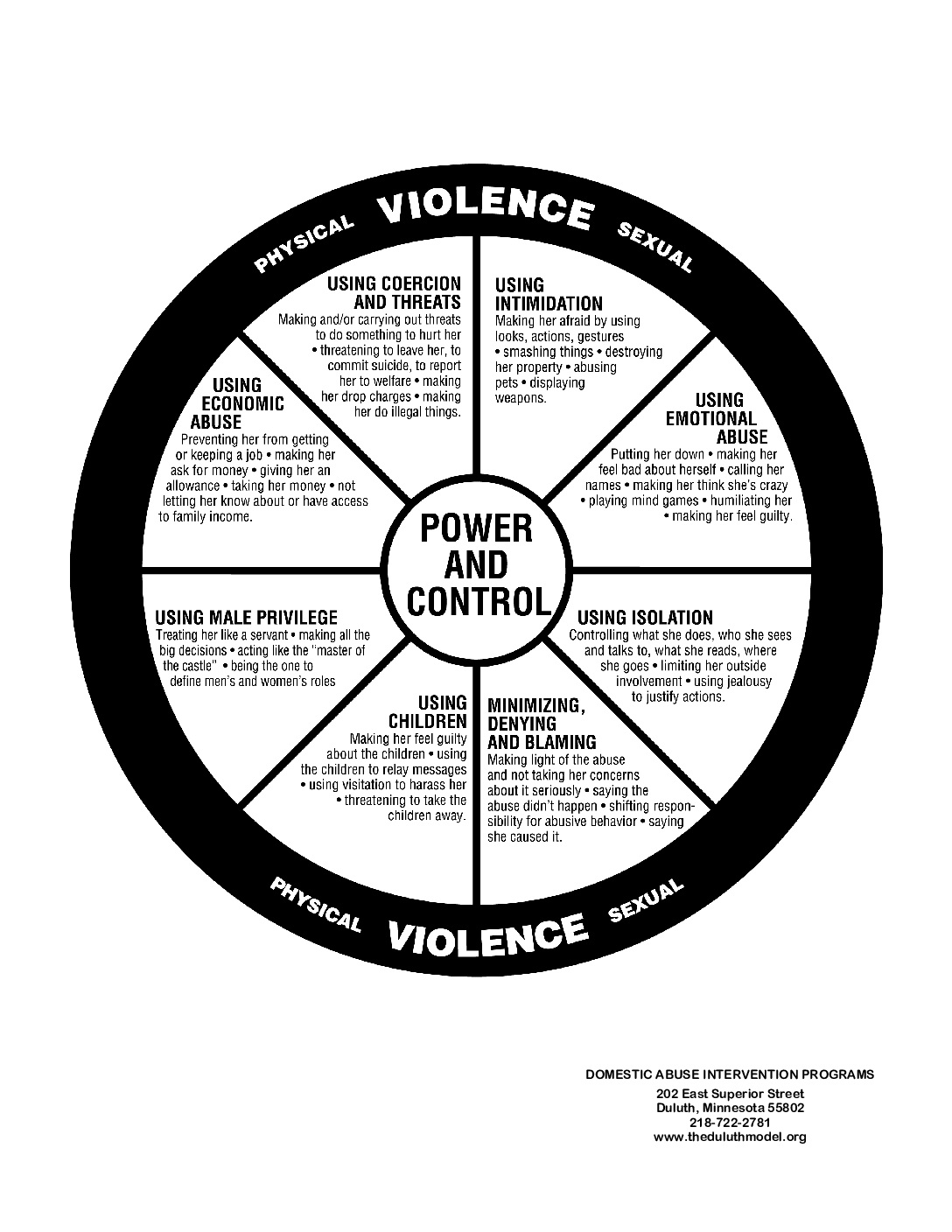
The Power & Control Wheel is a tool for understanding the different ways abuse can occur within a relationship.
At the center is power and control.
Surrounding it are behaviors an abusive partner may use to maintain that control, including:
- Intimidation
- Emotional abuse
- Isolation
- Minimizing, denying, and blaming
- Using children
- Using male privilege
- Economic abuse
- Coercion and threats
The outer ring represents physical and sexual violence.
One of the most important things the wheel illustrates is that physical violence is not the only form of abuse. The behaviors surrounding it can be ongoing and sometimes much harder to recognize. The Hotline explains that these less visible tactics can reinforce a pattern of control, while physical and sexual violence may further intensify fear and control.
Abuse isn't always obvious
Abusive relationships don't always begin with behavior that looks obviously dangerous.
Sometimes control begins in ways that can be mistaken for love, concern, jealousy, or protectiveness.
“I just worry about you.”
“I don't like your friends.”
“If you loved me, you would…”
“You don't need anyone else.”
Over time, those behaviors can become increasingly controlling.
The Hotline notes that warning signs can emerge and intensify as a relationship develops. These can include preventing someone from spending time with friends or family, controlling finances, preventing independent decision-making, pressuring someone sexually, intimidation, threats, and destroying property.
Not every relationship looks the same, and not every abusive relationship involves every behavior on the wheel. But learning to recognize patterns can help us better understand what abuse can look like.
Why this matters when we remember Holly
For us, this isn't just a conversation about a wheel on a website.
It's personal. Holly was murdered by her boyfriend. But Holly was so much more than the circumstances of her death.
Holly was a daughter. A sister. A friend. She was loved deeply by the people who knew her. She was vibrant, full of life, and loved being on the water. She had dreams, plans, people she loved, and so much life still ahead of her.
When we talk about domestic violence, it can be easy to focus on the statistics, the warning signs, or the moments that made the news. But behind every statistic is a person.
Holly.
That's why we believe conversations about power and control matter.
Because abuse doesn't always look the way we expect it to. It isn't always obvious from the outside. It can happen quietly, gradually, and behind closed doors. And by the time the danger becomes unmistakable, a person may already be deeply isolated or afraid.
We can't change what happened to Holly.
But we can choose what we do with her story.
We share Holly's story because we want her to be remembered for the life she lived, not only the way it ended.
At the same time, we cannot separate her story from the reality of domestic violence. Her death is a devastating reminder of why understanding power and control matters and why recognizing the signs of abuse can be so important.
We can learn. We can recognize the signs. We can listen when something doesn't feel right. We can stop dismissing controlling behavior as jealousy, protectiveness, or simply "relationship problems."
And we can remember Holly for who she was, not only for how she died.
Her life mattered.
Her story matters.
And if sharing her story helps even one person recognize something they couldn't put into words before, then her memory can continue to make a difference.
Look beyond the obvious
The Power & Control Wheel gives us a way to understand the behaviors that can exist within an abusive relationship, many of which may not look like violence at first.
One of the most important lessons of the Power & Control Wheel is that abuse is bigger than a single incident.
The Hotline explains that domestic violence is a pattern, and that multiple forms of abuse can occur at the same time. Physical violence may be the most visible part of that pattern, but emotional, financial, sexual, psychological, and other forms of abuse can also have profound effects.
That means we should pay attention to the behaviors that can be easier to dismiss:
Who makes the decisions?
Who controls the money?
Who is allowed to see friends and family?
Does someone feel afraid of their partner's reaction?
Is someone constantly being monitored, criticized, threatened, or made to feel responsible for the abuse?
Can they say no without fear of what will happen next?
These questions can help us recognize that domestic violence isn't simply about what happens during an argument. It is about patterns of behavior and the use of power to control another person.
Learn the wheel. Know the signs. Start the conversation.
You don't have to be an expert to learn about domestic violence.
You don't have to know exactly what to say to someone who may be experiencing abuse.
And you don't have to wait until something becomes physical to take concerning behavior seriously.
Learning the Power & Control Wheel is one place to start.
We encourage everyone to take a few minutes to read through the wheel and learn more about the different forms abuse can take.
Learn more about the Power & Control Wheel through The National Domestic Violence Hotline
The Hotline offers additional resources for recognizing abuse, understanding relationship abuse, and supporting someone who may be experiencing it. Their advocates are available 24/7.
For Holly
Control is not love. Fear is not love. Isolation is not love. Abuse is not love.
We will continue to tell Holly's story because she mattered.
Because her life mattered.
Because the people who loved her still carry her with them.
And because we believe that remembering Holly can also mean helping others recognize the signs of abuse, understand the dynamics of power and control, and know that they are not alone.
Holly's story is more than how she died.
It is a reminder to look closer, listen without judgment, believe people when they tell us something doesn't feel right, and learn what healthy relationships—and unhealthy ones—can look like.
For Holly.
For survivors.
For those who are still trying to understand what is happening.
And for the people who may one day be in a position to recognize the signs and help someone they love.
Learn the wheel. Know the signs. Speak up.
.jpg)


%20(1).png)

%20(5).png)